
Full-cycle production
quality · reliability · durability
1. Scrap processing
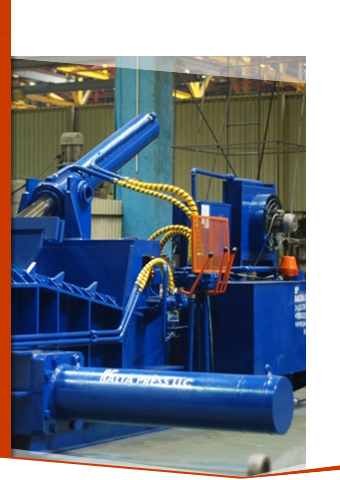
At this stage, materials are prepared for the melting process. The quality of preparation directly impacts both the alloy grade/purity and the overall cost-efficiency of production. During the melting of aluminum scrap, a portion of the material inevitably oxidizes and turns into dross (slag).In our production, we utilize A7 and A8 grade primary aluminum ingots, supplemented by high-quality scrap, including electrical components, food-grade packaging, industrial aluminum waste, and end-of-life architectural structures. By recycling scrap, we reduce production costs and provide a “second life” to decommissioned industrial and consumer products.Before the melting process begins, the scrap undergoes a rigorous cleaning process to remove ferrous inclusions and contaminants. Subsequently, the raw material is compacted into briquettes. This increases the yield of the usable alloy and significantly reduces furnace charging time.
2. Casthouse
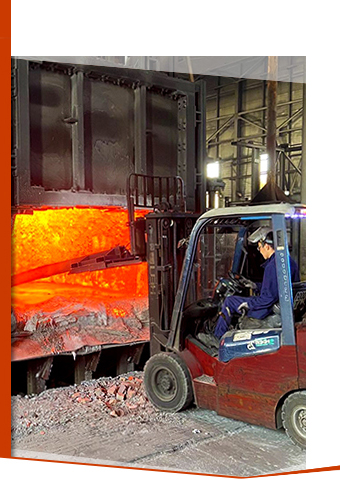
The first production cycle is a metallurgical complex for the manufacture of cylindrical billets from wrought aluminum alloys. The process of manufacturing billets of the required diameter includes: mechanical charging of the raw material into the furnace; melting of the charge in the melting and casting unit; transfer of the aluminum melt into a holding furnace; alloying; refining; degassing and filtration of the melt through ceramic foam filters; grain refinement using Al-Ti-B master alloys to obtain a fine-grained structure during crystallization; casting of aluminum cylindrical billets on semi-continuous casting units; homogenization of the billet structure. The company produces aluminum billets up to 6000 mm in length with diameters of 152 mm and 203 mm from AA 6060, AA 6063, AA 6463, AA 6082, and AD-0 alloys. Production volume is up to 1350 tons per month, 16200 tons per year.
3. Extrusion Plant
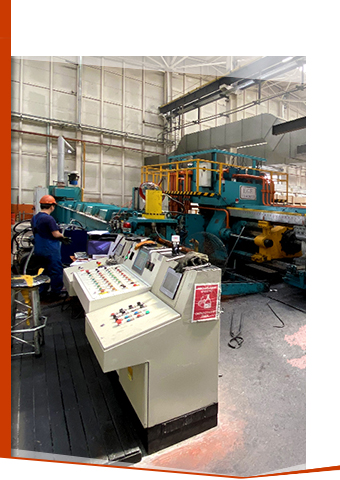
The extrusion plant of the factory produces complex cross-section profiles for construction, mechanical engineering, and general-purpose applications using the extrusion method from AA 6060, AA 6063, AA 6463, AA 6082, and AD-0 alloys. Extrusion technology is one of the most advanced methods in the production of aluminum profiles. Extruded aluminum alloy profiles are a versatile structural material with unique properties. The extrusion plant is equipped with two press lines with a total capacity of 900 tons per month, 10,800 tons per year. Each line consists of a press, a run-out conveyor, a puller, a stretcher, and a cutting line. The large press with a force of 2,400 tons is designed for billets with a diameter of 203 mm. The second press with a force of 1,540 tons is designed for billets with a diameter of 152 mm. The weight of extruded profiles ranges from 0.09 kg/m to 15 kg/m. The length of the profiles ranges from 3.0 m to 12.0 m.
4. Powder Coating Plant
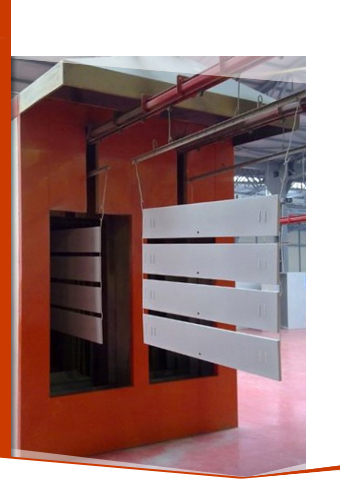
The powder coating plant performs surface coating of profiles using electrostatic powder painting methods. The capacity of the coating line is up to 400 tons per month, 4,800 tons per year. The coating process consists of the following stages: surface treatment on polishing equipment; water rinsing; profile etching in a degreasing tank; passivation; drying of profiles; hanging profiles on the conveyor; application of powder paint in a spray booth; passage through a continuous curing oven for polymerization.
5. Anodizing Plant
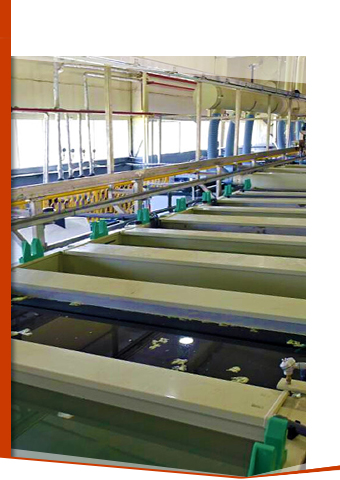
Anodic oxide coating is one of the options for professional surface finishing. The surface consists of a porous, transparent layer of aluminum oxide $Al_{2}O_{3}$. The thickness of the anodic coating depends on the duration of the anodizing process and can vary from 6 to 21 microns, depending on the product’s operating conditions. The standard technological process consists of key operations: degreasing, etching, desmutting, anodizing, and sealing. The plant performs both clear anodizing (“silver” color) and color anodizing. Color anodizing is carried out using a two-stage electrochemical method. First, clear anodizing of a specified thickness is performed, then metal microparticles are deposited from a salt solution into the pores of the oxide film under the influence of pulsed electric current. To obtain “light bronze,” “champagne,” “old bronze,” and “black” colors, tin microparticles are deposited. Coloring in “gold” is achieved in an ammonium ferric oxalate solution by filling the coating pores with a golden pigment. The color intensity depends on the duration of the electrochemical process. The final operation is treating the products in boiling distilled water. Anodized coatings are resistant to UV rays and atmospheric exposure.
6. Rolling and packing
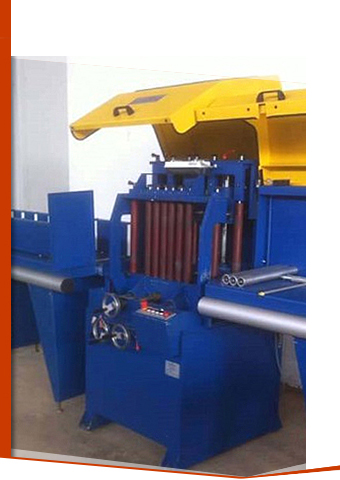
The rolling of profiles with thermal barriers is performed on modern equipment with regular shear tests. To eliminate errors, a dedicated standard has been developed for each profile, specifying component article numbers and rolling parameters. Finished profiles are stored and transported in protective packaging or containers. This includes custom-made wooden and cardboard crates, as well as metal racks. Products with powder-coated or anodized finishes are additionally protected with specialized adhesive tapes, which must be removed after the installation of the finished structures. These tapes protect the profiles from mechanical damage during transport and installation, preserving the aesthetic appearance of the aluminum structures during finishing works; when instructions are followed, they are easily removed without leaving residue on the profile. Proper packaging ensures reliable protection of the products from damage and loss, while also simplifying transportation, storage, and sales.
7. Finished Goods Warehouse
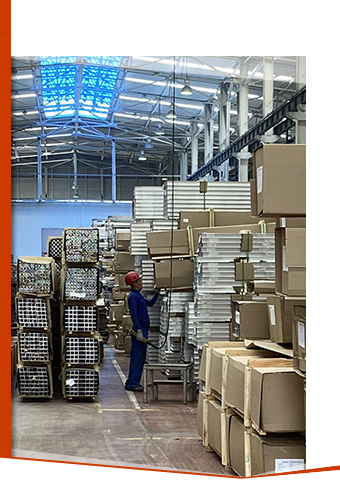
At all stages of production, products are checked for compliance with safety and quality standards. Only goods that have passed all inspection stages are dispatched to the customer. Loading is carried out using lifting machinery, forklifts, as well as manually. Delivery is performed via road freight transport. Every month, the plant dispatches up to 900 tons of aluminum profiles.